How can you tell the difference between a venomous and a non-venomous snake? Start by looking at their heads and necks, says Melissa Kyle, a naturalist at Houston Arboretum. Broad-banded and diamondback water snakes are sometimes confused for the venomous cottonmouths, also known as water moccasins.
If you see thick, triangular heads, then you’re looking at a cottonmouth snake, Kyle says. These snakes also have stocky bodies to go with their big heads, but thin and distinctive necks. By contrast, a rounder and narrower head is distinctive of a water snake, whose bodies are generally slender. Water snakes don’t boast a distinctive neck.
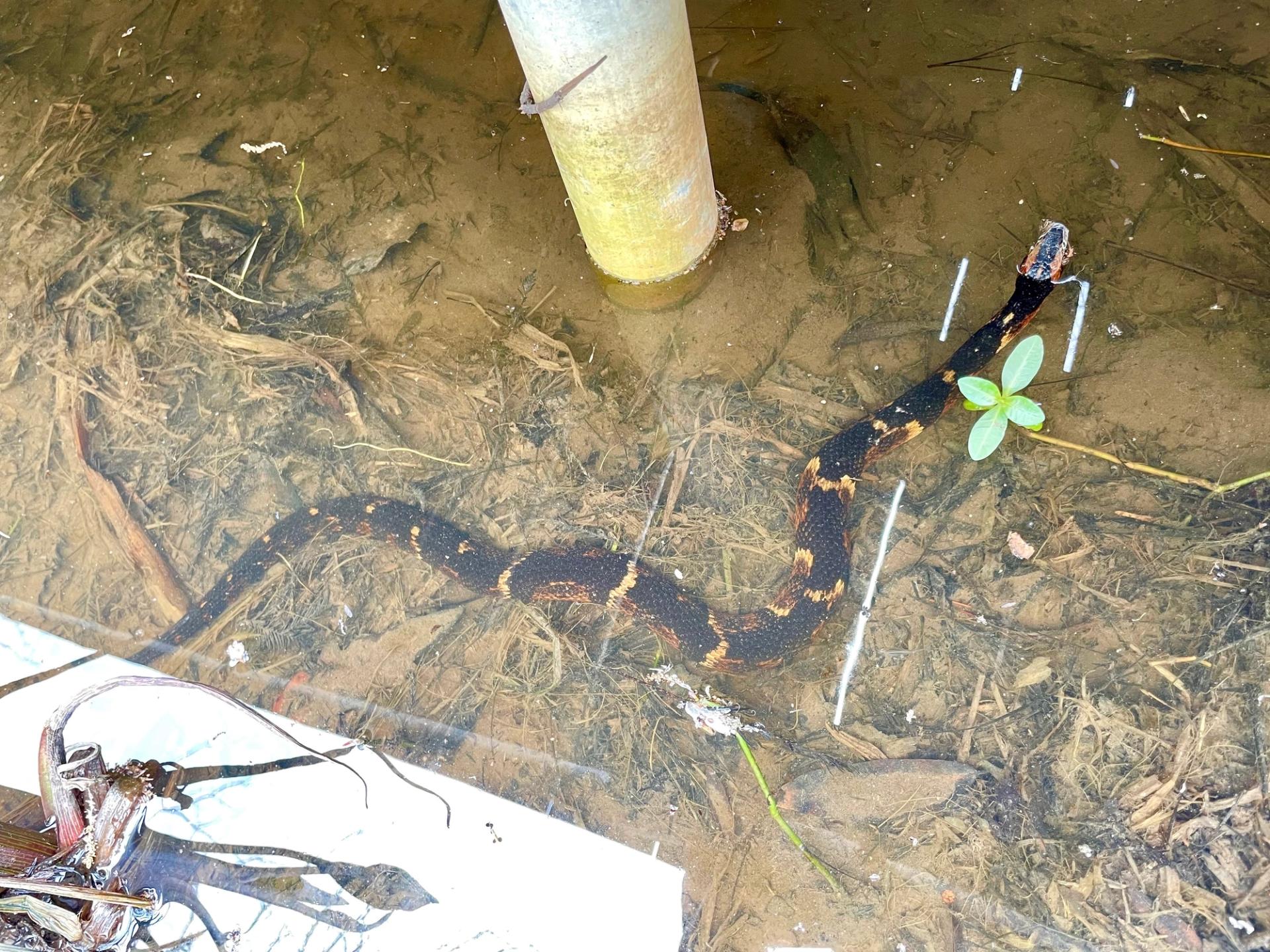
There are also significant differences in how they swim, Kyle adds. While both snakes catch prey underwater, cottonmouths generally swim with their body on top of the surface and head out of the water. The water snake tends to keep its body and head just under the surface.
Unfortunately, you won’t find cottonmouths at the Arboretum, but Kyle says you can find broad-banded and diamondback water snakes in the Arboretum’s ponds.
“Always exercise respect and caution around any snake,” Kyle reminded me in an email.
Broad-banded snakes also have irregular-shaped dark blotches across their body, ranging in brown to yellowish gray. The diamondback water snakes, which are gray, light brown, or a dull yellow color, have diamond-shaped light markings on their back.