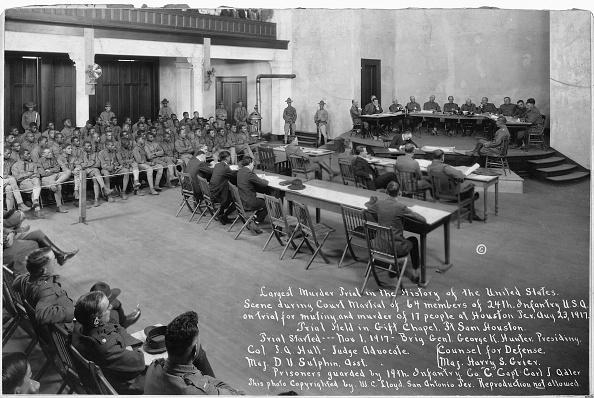
More than 100 years ago, Houston became the boiling point for a terrible racial tragedy and the largest court martial in U.S. military history. A group of Black soldiers accompanied by white officers came to guard the construction of Camp Logan — but things went terribly wrong, resulting in a chaotic riot and 19 deaths. Today, the tragedy remains a painful memory in Houston’s history. So, what happened?
Before the Riot
When the United States entered World War I in 1917, a Houston construction company built Camp Logan in what is today the eastern edge of Memorial Park. It was intended to be a site to train National Guard troops, and on July 27, 1917, a group of famed Buffalo Soldiers from the 3rd Battalion, 24th Infantry Regiment, traveled to Houston with seven white officers to guard the camp. Some of the Black soldiers were from northern states, and were used to respectful treatment as Army servicemen. Now in the South, they found segregation enforced, and in Houston, they faced growing racial tensions. Over the next few weeks, Black soldiers endured racial slurs from white laborers at Camp Logan’s construction site. They had to stand in the back of streetcars, despite vacant seats being open in the “White” section. Houston police officers also hurled insults at the Black soldiers. Things reached a tipping point on August 23, 1917, when a Black soldier interfered in the arrest of a Black woman in Fourth Ward. He was arrested by two police officers around noon.
What Happened During the Riot
Corporal Charles Baltimore, a Black military policeman who was part of the battalion in Houston, went to inquire about the soldier’s arrest. His questions were met with violence: A police officer hit Cpl. Baltimore on the head. The police also fired gunshots at the military policeman, chasing him into an unoccupied house before taking him to police headquarters. Over at Camp Logan, a rumor spread that Cpl. Baltimore had been shot and killed. Angry about the incidents, a group of 100 Black soldiers decided to march from Camp Logan into downtown Houston. Terrible violence erupted during the two-hour march. In total, 19 people were killed, including four Houston policemen and four soldiers.
After the Riot and its Legacy
After the violence in Houston, the Army held the largest U.S. court martial trial in its history, and found 110 soldiers guilty. Sixty-three defendants received life sentences, and 19 soldiers were hanged. The first 13 soldiers were hanged in secrecy only a day after sentencing, and before the verdict was even made public. No white residents or police officers were tried; two white Army officers were honorably discharged from active duty. Many people within the Black and military community felt the Buffalo Soldiers had been served an injustice. The South Texas College of Law petitioned the Army to review the convictions in 2020 and 2021. Retired general officers also requested the Army grant clemency to all 110 soldiers. After reviewing the cases, the U.S. Army overturned all the 110 court-martial convictions in November 2023, and said the soldiers had been “wrongly treated because of their race and were not given fair trials.”
Today, you can honor the legacy of the Buffalo Soldiers who were executed in the wake of the Camp Logan riot by listening to the stories from descendants and other community members. The Ensemble Theatre is also honoring the history this month, with their play, “Camp Logan,” showing through Feb. 23rd.